Thursday, October 24, 2013

2 Commercial Property Giants to Combine in $7.2 Billion Deal

Summary:  Cole Real Estate Investments has agreed to be acquired (along with $4 billion of Cole's debt) by American Realty Capital Properties in a $7.2 billion cash and stock deal that will combine two of the largest commercial real estate owners in the the US, after nearly seven months of negotiations.  This comes after American Realty spent the summer acquiring companies to increase its capitalization.


New York --(New York Times DealBook)--
American Realty Capital Properties and Cole Real Estate Investments, two of the largest commercial property owners in the country, are finally seeing eye to eye.

The two real estate investment trusts agreed to a $7.2 billion deal on Wednesday in which American Realty will buy Cole with a mix of cash and stock, bringing an end to tensions between the companies that have simmered much of the last yearThe combined company will be one of the biggest commercial landlords in the country, leasing space to companies including FedEx, AT&T, CVS, Walgreens and Home Depot. American Realty will also take on about $4 billion in debt from Cole.

The origins of the deal date to March, when American Realty made an unsolicited offer for Cole that would have derailed Cole’s move to go public. Cole rejected the offer and went on to list on the New York Stock Exchange. Since the listing in June, Cole shares have climbed more than 17 percent.

Nonetheless, American Realty still wanted to make a deal. It will pay 14 percent above Cole’s closing stock price on Tuesday of $12.82, and assume significant new debt in taking over the larger company.

“These two companies were meant to be together,” American Realty’s chief executive Nicholas S. Schorsch said in an interview. “This is a one plus one equals four or five scenario.”

Under the terms of the deal, Cole stockholders can choose either 1.0929 shares of American Realty stock, valued at $14.59, or $13.82 cash for each Cole share.

Commercial real estate investment trusts are in vogue right now because they pay almost no corporate taxes and return most earnings to investors through dividends, making them attractive stocks for investors to own.

Both American Realty and Cole operate in the lucrative “net lease” market, meaning they offer large and stable commercial customers long-term leases, and leave the maintenance and operations of the properties up to the tenants.

Over the summer, as Cole’s shares debuted on the public market, American Realty, which had been the smaller of the two companies, went on a shopping spree, acquiring several billion dollars in assets.

“These are two comparably sized companies now,” Cole’s chief executive Marc Nemer said in an interview. “The discussions this go round were friendly and were all about maximizing value for shareholders.”

As part of the deal, American Realty plans to increase its dividend to $1. And despite taking on additional debt, it expects its overall leverage ratio will come down by the end of next year.

American Realty shares were down 1.5 percent at midday on Wednesday.

“This was a once in a life time moment when you actually have a perfect storm for these two companies to come together,” said an ebullient Mr. Schorsch. “You can say put Ford and General Motors together, but it doesn’t always work. This really is a phenomenal union in a moment in time that may never come again.”

Barclays and RCS Capital advised American Realty, and Proskauer Rose provided legal advice. Goldman Sachs advised Cole, and three law firms — Wachtell, Lipton, Rosen & Katz; Venable; and Morris, Manning and Martin — provided legal advice. Christopher H. Cole, the chief executive of Cole, and other executives received legal advice from Sullivan & Cromwell.http://dealbook.nytimes.com/2013/10/23/2-big-commercial-property-owners-to-combine-in-11-2-billion-deal/

Thursday, October 17, 2013

Small firms discover buying beats renting

Summary:  Rents, apparently, have reached parity with ownership.  Many are incentivized by stabilizing rents and increasing mortgage rates.


Fort Lauderdale --(Sun Sentinel)--
Some small businesses in South Florida are finding it's better to buy than to rent. Entrepreneurs, law firms and marketing companies are becoming their own landlords, locking in occupancy costs before expected increases in mortgage and rental rates, brokers say.

"I think it's indicative of restored confidence in the economy that firms are willing to make longer-term commitments," said George Sacks, managing principal at Commercial Florida Realty Services in Boca Raton.

Commercial Florida has completed a handful of office condominium sales recently at Sanctuary Centre, a 187,000-square-foot complex in Boca Raton. Tenants also are buying at The Exchange, a six-building Fort Lauderdale complex.

PeytonBolin, a seven-attorney law firm in Tamarac, signed a lease in 2008 — during the height of the recession when office rents "were dirt cheap," founding partner Mauri Peyton said.

When it came time to renew, Peyton couldn't get as good of a deal in his building — or anywhere else. The more he looked at the firm's costs, the more he realized it could probably buy space for as much as it could rent it.

PeytonBolin, which represents condo and homeowner associations through Florida, agreed to buy a 6,240-square-foot office suite at The Exchange. Peyton said the monthly ownership costs will be about the same as renting, but the tax benefits make buying the much better bargain.

"Rather than just throwing money away on rent, we're building equity," he said. "We don't have to worry about a landlord or losing our build-out money when we leave."

PeytonBolin and other firms want to act now before mortgage rates inch up further. And commercial rents are due to increase as well, given the lack of construction over the past few years, Sacks said.

Another advantage to buying: A more favorable lending environment, brokers say. Businesses can get up to 90 percent financing on loans backed by the Small Business Administration.

For some, renting is the smarter option for many larger firms and those that crave flexibility.

"If you are uncertain about whether your space needs are going to change, it may not make sense for you to buy," said John McQueston, a broker associate with Campbell & Rosemurgy in Pompano Beach.

Tuesday, October 15, 2013

CMBS.com redesign plus CMBS.com Mobile


Summary:  CMBS.com redesigned their website to include improved free searches by point and radius, and a new mobile site.


Sausalito --(CMBS.com and Backshop)--
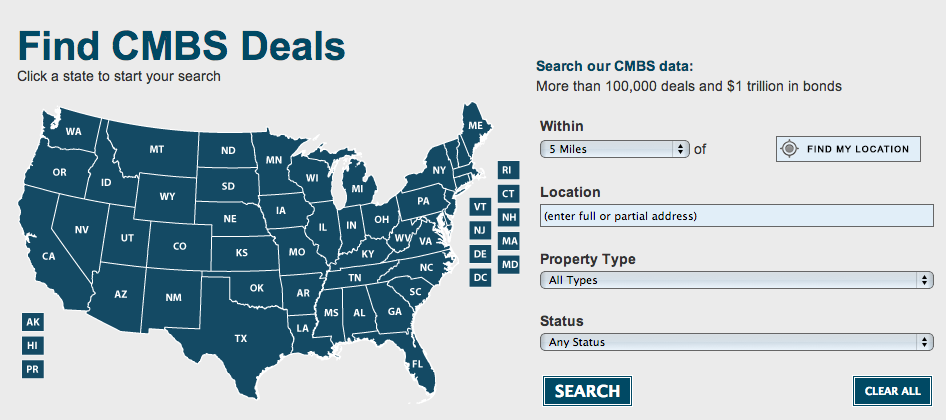
We redesigned the www.CMBS.com web site and added some great new features. Check ‘em out:

First, we have improved our free searches to include more data than ever and a map-based interface for more intuitive searches.

The deal searches now feature a “radius” query allowing the user to filter CMBS deals around a specific address. If you have a property and want to see what CMBS deals are nearby, it is a great tool.


My favorite part of the new site is the mobile version of CMBS.com. If you go to www.CMBS.com on a mobile device, the site will ask your browser for its location, and the deal search will default to a five-mile radius around your location.


Tweak your search filters as appropriate, hit SEARCH DEALS, and browse the available deal data. I was in New York City last week and had fun walking around learning about all the different buildings.

For CMBS investors, the securitization search tools are better than ever. Now you can search by specific CUSIPS. When you sign up for a free account, you can set up your Investor Dashboard and model loan loss and bond loss scenarios.


The last thing to point out on CMBS.com is the introduction of the CMBS borrower reporting tool. This new feature is designed for existing CMBS borrowers to track and standardize their quarterly reporting obligations. The reporting includes an XML version (of course!). We will be working with the servicers and borrowers to promote adoption of the service.

Fitch: Canadian CMBS Market Stable, Losses Rare

Summary:  Canadian CMBS returns, specifically office and retail, are expected to be positive, though tempered by comparison to recent years.  Conservative lending, recourse loans, and low volume issuance have contributed to low default rates for Canadian CMBS (1.9% default rate in Canada compared to 13.7% in US).  Stable employment, low vacancy rates, rent growth in Montreal and Vancouver, oversupply of condos in Toronto and Montreal, and economic growth stemming from the oil and gas industry in Alberta, Manitoba, and Saskatchewan are expected.


New York --(Business Wire)--
Canadian CMBS will likely perform positively in the near term, Fitch Ratings says. We expect retail and office properties to be positive but slightly lower than they have in recent years. Also, Canadian transactions have had extremely low default rates over the past 15 years. In 2Q13, we calculate a cumulative default rate of 1.9% of issuance by balance. The U.S. rate for the same period was 13.7%. In our view, more conservative lending, the commonality of recourse loans, and the relatively small amount of Canadian CMBS issuance and lending explain much of the difference.

Our view of the office market is rooted in our expectation that Canadian unemployment will remain stable through 2015 at approximately 7%. Nationwide the average vacancy rate in the second quarter was 8.7%. Rents have been growing in Montreal (4.2%) and Vancouver (3.0%) over the prior year.

Over the longer term, we observe some trends in multifamily housing that could slow its growth. The vacancy rate at the end of the second quarter was under 3%. But an oversupply of condominiums in Vancouver and Toronto may be forming. Those markets also have higher youth unemployment rates than the rest of Canada.

We expect the Canadian economy to grow 2% annually from 2013 to 2015. Much of the strongest growth has been in Alberta, Manitoba, and Saskatchewan and is partially attributable to the expansion of the oil and gas industry in those provinces.
http://www.businesswire.com/news/home/20131014006126/en/Fitch-Canadian-CMBS-Market-Stable-Losses-Rare

Monday, October 14, 2013

Bridging the financing gap: New funds could inject $220M to spur commercial development

Summary: Foreclosure- and repossession-ridden Michigan has been left with little access to liquidity from banks and investors.  In response, the Michigan State Housing Development Authority (MSHDA) is launching a $100 million mezzanine fund for multi-family, mixed-used and residential projects throughout the state.  Similarly, Great Lakes Capital Fund is working toward a $120 million fund allocated to underwriting loans to Michigan developers.  Meanwhile, regional banks have used the real estate rebound to clear foreclosed and repossessed houses from their balance sheets.  Developers and entrepreneurs are hoping that these funds will help with second tier funding to close the gap between <60% LTV and equity investors who are looking for more leverage.


Grand Rapids --(MiBiz)--
Commercial real estate developers in West Michigan could soon get some much needed relief from their struggles to access bank financing.

Still smarting from the millions in losses they incurred from foreclosed and repossessed properties, banks are keeping the purse strings tight on loans for commercial real estate projects. That has developers facing a financing gap in the market as the economy improves.

“There is a (financing) gap out there,” said Michael Price, chief executive officer of Grand Rapids-based Mercantile Bank Corp. “There are lots of good ideas that have come not only in the real estate market, but in manufacturing and other commercial opportunities where there just needs to be that level of debt that has a bit of higher risk profile than what a traditional bank financing package looks like.”

With developers and banks finding it difficult to work the numbers on many potential projects, that’s left some in development limbo, Price said.

There may be some help on the horizon. Two new funds expected to hit Michigan markets next year with up to $220 million in project financing could help close the financing gap.

The Michigan State Housing Development Authority (MSHDA) announced on Sept. 25 that it is launching a possible $100 million mezzanine fund with a focus on providing financing to urban multi-family, mixed-used residential projects across the state.

Also in September, MiBiz reported Lansing-based Great Lakes Capital Fund, via its Develop Michigan Inc. economic development arm, is working to close a $120 million offering for its Develop Michigan Real Estate Fund LP. Company officials say they plan to use the fund to provide capital for a program that would offer loans to commercial developers across the state.

It’s often the case that developers and entrepreneurs just don’t have access to the necessary equity that would make banks comfortable in extending the financing needed to push a project forward, Price said. Banks also just went through an intense period of trying to shed foreclosed assets from their balance sheets and salvage the losses from collapsed deals. In essence, they’re not in any hurry to risk adding more bad debt, he said.

Developers say they can typically get a bank loan for 50 percent to 60 percent of the total cost of a deal, but while they’re willing to put some equity into the projects, they’re still often left with a 30-percent funding gap. That’s created a need for a funding source that’s willing to come in and be last piece of capital that fits between senior debt and equity so that deals can move forward, said Chris LaGrand, chief housing investment officer at MSHDA.

With the availability of these funds, owners and developers have more financing options in structuring a difficult deal and more investors would have reason to invest in Michigan, LaGrand said.

Kalamazoo-based developer Tom Huff, owner of Peregrine Realty LLC, said the new funds could help fill a lending gap that’s been making it difficult to finance projects.

“It seems like these are great ideas that just open more options for developers,” Huff said. “Right now, the banks are timid and the appraisal market is also timid, so (these funds) make some sense.”

It’s no surprise that banks tightened their underwriting standards for property developments after the recession.

Local banks accumulated millions in foreclosed and repossessed real estate on their books in the recession. Deals with just one Holland-based developer, Scott Bosgraaf, left banks holding roughly $24 million in unpaid real estate loans and bad debt.

But Dan Yeomans, whose turnaround firm has been involved in the sale of $12.6 million of those foreclosed assets, doesn’t think developers should bear all the blame for the banks’ losses. Bad lending practices were often just as much to blame as over-extended developers, he said.

“I don’t even know how some of those loans were given,” said Yeomans, president of Amicus Management.

As the economy has improved, banks have gotten rid of foreclosed or repossessed properties, what’s known as “other real estate owned” or OREO. Locally, Mercantile Bank Corp., Macatawa Bank Corp. and Independent Bank Corp. combined have cleared their balance sheets of $17.1 million in OREO between Dec. 31, 2012 and June 30 of this year.

But because banks are reluctant to lend even as the economy has picked up, developers can’t assemble enough project financing to be able to meet the demands of the market. That’s where the new mezzanine financing could help, even if it’s at a higher interest rate and adds complexity to the deals, sources said.

While the new funds could make deals more complex in terms of layering different financing mechanisms and necessary paperwork, Price said the extra due diligence is worth it for a good project.

“In working a little with these types of funds and entities, they’ve made it fairly easy to work with, but of course, that’s always in eye of the beholder,” he said. “I’m not going to sugarcoat it, but every time you have another entity involved, that always includes another layer of paperwork and additional triggers and holds that need to be put in place. But all things considered, we think it’s eminently worth it for the entrepreneur or project team to spend the time.”

The process shouldn’t be so onerous that project managers will have to go out and hire a tremendous legal team to tackle the work, he said.

In the current market, many projects rely on the ability to secure building incentives primarily from state and local governments. At the same time, some incentives such as Renaissance Zones are retiring. Other incentives like the Michigan Economic Development Corp.’s Community Revitalization Program can help deals get off the ground, but the funds are always distributed on the back end of a deal when the project is complete.

Huff said his experience is that banks are reluctant to loan any more than 70 percent loan to value for projects despite the demand for urban residential development in many communities across the state. Those communities “need this kind of injection,” he said.

“This kind of keeps the momentum going,” Huff said. “There is definitely risk involved, but there is demand.”

Working in partnership with banks, MSHDA wants to identify a pipeline of deals that could unlock with the help of mezzanine debt, LaGrand said.

Given MSHDA’s strong portfolio of past successful projects, LaGrand believes the organization can convince investors to get involved in the Michigan market.

“We believe we have the history and market intelligence of doing deals in the state since 1960 that investors will find useful and attractive,” he said. “We’re thinking that we can offer investors an 8- to 10-percent yield, and the cost of the funds is around 14, 15, 16 percent. We think deals would pencil at those numbers.”

Right now, mezzanine debt is offered at around a 25-percent interest rate in some markets, which LaGrand said is a “go-away price.” Investors know deals don’t pencil at that rate, but initial conversations with investors have been positive, LaGrand said, noting the experience and market knowledge MSHDA can bring to the table.

The mezzanine fund is seeded with $25 million of non-taxpayer MSHDA reserve funds.

“We obviously believe this fund is going to provide a good return, which is why we’re moving the money,” LaGrand said. “We’re probably looking at the middle of next year for the first closing.”

The fund’s target investment is mixed-used multifamily housing in urban cores, the cost of which can range widely. LaGrand hopes to unlock primarily large-scale multi-million dollar developments. One stipulation to access the financing: Projects must have at least 50 percent of their units set at market-rate values.

“We want to get as many strong deals into the pipeline as possible,” he said. “Ideally, we want to be 10 to 30 percent of the investment cost of the deal. So if our target investment might be $10 to $20 million — depending on what percentage of the deal we are — you’re talking a $50 million real estate investment. That’s sort of the base level, and we can go higher.”

Given the potential returns for investors and MSHDA’s track record, Price of Mercantile Bank said he thinks the fund makes sense. He expects investors are really going to kick the tires on projects because of it.

“It all depends on the risk profile of projects,” he said. “(Investors) are clearly going to demand a higher return, but they are going to fill that gap that we think is going to allow some ideas and projects to go that may not have come to fruition — and hopefully provide a lot of job growth.”

http://mibiz.com/news/real-estate/item/20998-bridging-the-financing-gap-new-funds-could-inject-