The concept of syndicate investment and indirect investment in commercial property through vehicles such as investment funds and REITs is firmly established.
Investors, who may not otherwise have the expertise or financial wherewithal to purchase commercial real estate in their own right, essentially pool their resources and purchase property as part of a larger group. Considering the extent to which technology is advancing and new concepts are emerging, it is conceivable that a new phenomenon may reach us before long - that is the concept of "crowdfunding", which is becoming increasingly popular in real estate in the US and gaining traction in Europe and Asia.
Crowdfunding or peer-to-peer lending is described as "the practice of funding a project or venture by raising many small amounts of money from a large number of people, typically via the Internet".
There are now several well-established crowdfunding platforms including Kickstarter, Indiegogo, Rockethub, and Crowdcube, among others. Most of these are US platforms that have been expanding overseas into Europe and elsewhere. These platforms enable start-up businesses and entrepreneurs to launch and promote their business ideas online and give investors an opportunity to invest in this idea, often for a relatively small outlay.
It goes without saying that investing in start-ups and early stage businesses, whether through crowdfunding or otherwise, involves considerable risks, including illiquidity, lack of dividends, loss of investment and dilution. Crowdfunding should therefore only be undertaken as part of a diversified investment portfolio.
Property crowdfunding is the fastest growing segment of the market today. Following some regulation changes in the US in 2012, commercial real estate sponsors obtained the ability to broadly solicit and advertise to the public. This opened the door for real estate developers and owners to capitalize on modern digital marketing tools and leverage the reach of the Internet to reach a wider potential investor base. A study from Massolution reported that $2.5bn of crowdfunding occurred in the real estate sector in 2014 and this continues to rise.
A number of specialist real estate platforms are now in operation in the US including RealCrowd, Crowdstreet, Fundrise and Prodigy Network. In fact, the largest crowdfunding campaign ever was a real estate crowdfunding project organised by Prodigy Network. Its founder Rodrigo Niño has predicted that "Crowdfunding will disrupt the status quo of traditional equity investment in real estate."
In 2009, Niño helped build the first skyscraper in Bogota, Colombia, in 40 years. He financed much of the project by attracting small investors who invested $20,000 at a time. By 2013, he had raised over $190m for the BD Bacata project - a world record in crowdfunding. Many of the investors in this project, which has recently been completed, made returns of more than 40pc since purchasing shares. Prodigy Network has since moved on to other successful projects in New York including AKA Wall Street, 17 John and AKA United Nations. Another real estate crowdfunding vehicle Fundrise is currently offering approved investors an opportunity to invest in 3 World Trade Centre in New York.
These specialist real estate crowdfunding entities are targeting up to 10 million accredited investors in the United States who are looking for solid returns on tangible assets that can generate private equity type returns. Accredited individual investors can research the best private real estate operating companies, view current offerings, submit offers, fund investments and manage their commercial real estate portfolios from their personal crowdfunding accounts. The portfolio valuation of the largest real estate crowdfunding platform Prodigy Network's now stands at over $600m. They claim to have over 5,200 accredited investors on their books. Interestingly, they are now reportedly looking for institutional quality investment opportunities in Europe.
However, crowdfunding isn't yet an option for all interested in investing in commercial property. Although the core principle of crowdfunding is affording small investors the opportunity to invest in particular projects for relatively little outlay, many of the well-established real estate crowdfunding platforms in the US have high thresholds for accredited investors. To become an accredited investor and to be able to browse open investments on certain real estate crowdfunding platforms, in some cases you are required to have a net worth of at least $1m and to prove that you have a minimum annual income of $200,000 over a number of years in order to be accredited.
If you meet these criteria, you undoubtedly already have access to direct real estate investment opportunities and may prefer to invest in real estate in this way as opposed to pooling resources with many other investors on a crowdfunding platform in order to achieve a similar rate of return. However, as time goes on, these thresholds are likely to reduce giving a greater pool of potential investor's opportunities to invest in commercial property through crowd funding.
In a European context, Spain, Germany and the UK are expected to follow the lead of Italy, which recently became the first country to implement a law on equity crowdfunding.
The property industry is now fully au fait with syndication and REITs and the concept of collectively investing in large and diversified portfolios of commercial real estate across different geographies and jurisdictions. However, the likelihood is that technology will alter current models and streamline investment processes over the next few years with accredited investors increasingly evaluating the merits of investing in particular funds or schemes via highly supportive data rooms and websites in the first instance and making their actual investment via transparent crowdfunding type platforms. Over the last few years, technology has eliminated middle men and increased efficiencies in a plethora of different industries and it has the potential to do likewise in the real estate industry. Real estate crowdfunding has seen exponential growth over the last few years and is likely to continue to grow over the course of the next few years, particularly as the regulatory framework becomes more developed in many jurisdictions.
Showing posts with label US. Show all posts
Showing posts with label US. Show all posts
Sunday, June 7, 2015

Tuesday, January 20, 2015
IMF: Global Growth Revised Down, Despite Cheaper Oil, Faster U.S. Growth
Even with the sharp oil price decline—a net positive for global growth—the world economic outlook is still subdued, weighed down by underlying weakness elsewhere, says the IMF’s latest WEO Update.
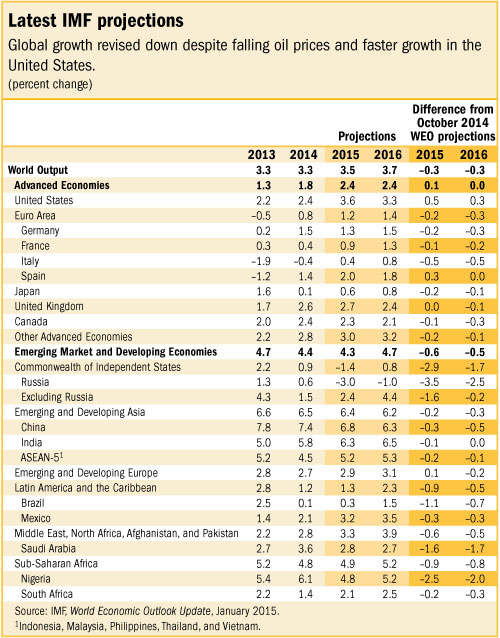
Global growth is forecast to rise moderately in 2015–16, from 3.3% in 2014 to 3.5% in 2015 and 3.7% in 2016 (see table), revised down by 0.3% for both years relative to the October 2014 World Economic Outlook (WEO).
Recent developments, affecting different countries in different ways, have shaped the global economy since the release of the October WEO, the report says. New factors supporting growth—lower oil prices, but also depreciation of euro and yen—are more than offset by persistent negative forces, including the lingering legacies of the crisis and lower potential growth in many countries.
“At the country level, the cross currents make for a complicated picture,” says Olivier Blanchard, IMF Economic Counsellor and Director of Research. “It means good news for oil importers, bad news for oil exporters. Good news for commodity importers, bad news for exporters. Continuing struggles for the countries which show scars of the crisis, and not so for others. Good news for countries more linked to the euro and the yen, bad news for those more linked to the dollar.”
Cross currents in global economy
In advanced economies, growth is projected to rise to 2.4% in both 2015 and 2016. Within this broadly unchanged outlook, however, is the increasing divergence between the United States, on the one hand, and the euro area and Japan, on the other.
For 2015, the U.S. economic growth has been revised up to 3.6%, largely due to more robust private domestic demand. Cheaper oil is boosting real incomes and consumer sentiment, and there is continued support from accommodative monetary policy, despite the projected gradual rise in interest rates. In contrast, weaker investment prospects weigh on the euro area growth outlook, which has been revised down to 1.2%, despite the support from lower oil prices, further monetary policy easing, a more neutral fiscal policy stance, and the recent euro depreciation. In Japan, where the economy fell into technical recession in the third quarter of 2014, growth has been revised down to 0.6%. Policy responses, together with the oil price boost and yen depreciation, are expected to strengthen growth in 2015–16.
In emerging market and developing economies, growth is projected to remain broadly stable at 4.3% in 2015 and to increase to 4.7% in 2016—a weaker pace than forecast in the October 2014 WEO. Three main factors explain this downward shift.
• First, the growth forecast for China, where investment growth has slowed and is expected to moderate further, has been marked down to below 7%. The authorities are now expected to put greater weight on reducing vulnerabilities from recent rapid credit and investment growth and hence the forecast assumes less of a policy response to the underlying moderation. This lower growth, however, is affecting the rest of Asia.
• Second, Russia’s economic outlook is much weaker, with growth forecast downgraded to negative 3.0% for 2015, as a result of the economic impact of sharply lower oil prices and increased geopolitical tensions.
• Third, in many emerging and developing economies, the projected rebound in growth for commodity exporters is weaker or delayed compared with the October 2014 WEO projections, as the impact of lower oil and other commodity prices on the terms of trade and real incomes is taking a heavier toll on medium-term growth. For many oil importers, the boost from lower oil prices is less than in advanced economies, as more of the related windfall gains accrue to governments (for example, in the form of lower energy subsidies).
Risks to recovery
The distribution of risks to global growth is more balanced than in October, notes the WEO Update. On the upside, lower oil prices could provide a greater boost than assumed. Other risks that could adversely affect the outlook involve the possible shifts in sentiment and volatility in global financial markets, especially in emerging market economies. The exposure to these risks, however, has shifted among emerging market economies with the sharp fall in oil prices. It has risen in oil exporters, where external and balance sheet vulnerabilities have increased, while it has declined in oil importers, for whom the windfall has provided increased buffers.
Policy priorities
The weaker global growth forecast for 2015–16 underscores the need to raise actual and potential growth in most economies, emphasizes the WEO Update. This means a decisive push for structural reforms in all countries, even as macroeconomic policy priorities differ.
In most advanced economies, the boost to demand from lower oil prices is welcome. It will also lower inflation, however, which may contribute to a further decline in inflation expectations, increasing the risk of deflation. Monetary policy must then stay accommodative to prevent real interest rates from rising, including through other means if policy rates cannot be reduced further. In some economies, there is a strong case for increasing infrastructure investment.
In many emerging market economies, macroeconomic policy space to support growth remains limited. But lower oil prices can alleviate inflation pressure and external vulnerabilities, giving room to central banks to delay raising policy interest rates.
Oil exporters, for which oil receipts typically contribute a sizable share of fiscal revenues, are experiencing larger shocks in proportion to their economies. Those that have accumulated substantial funds from past higher prices can let fiscal deficits increase and draw on these funds to allow for a more gradual adjustment of public spending to the lower prices. Others can resort to allowing substantial exchange rate depreciation to cushion the impact of the shock on their economies.
Lower oil prices also offer an opportunity to reform energy subsidies and taxes in both oil exporters and importers. In oil importers, the saving from the removal of general energy subsidies should be used toward more targeted transfers to protect the poor, lower budget deficits where relevant, and increase public infrastructure if conditions are right.
Subscribe to:
Posts (Atom)